The most labor-intensive area of a laundry is on the finishing side because it involves folding. The good news is that there are machinery options out there that can significantly reduce those labor hours, while upping production, quality and efficiency. Even better? While you might think investing in automation will break the bank, it won’t. Most folding systems pay for themselves in two years or less. And if you look to finance, the money saved in labor typically makes your monthly payment.
Value #1: Labor Savings & Bolstered Productivity
The leading reason to add a flatwork ironer or folder is to decrease labor costs and quadruple production. By adding automation — ironers and folders — laundries drastically cut labor and operational costs while catapulting throughput. Check out the following examples.
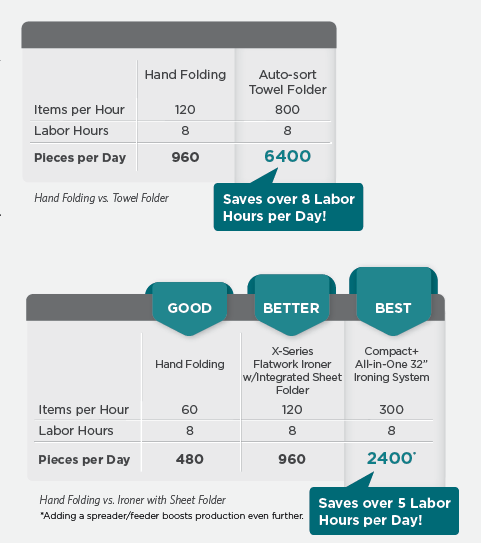
Hand Folding vs. Towel Folder
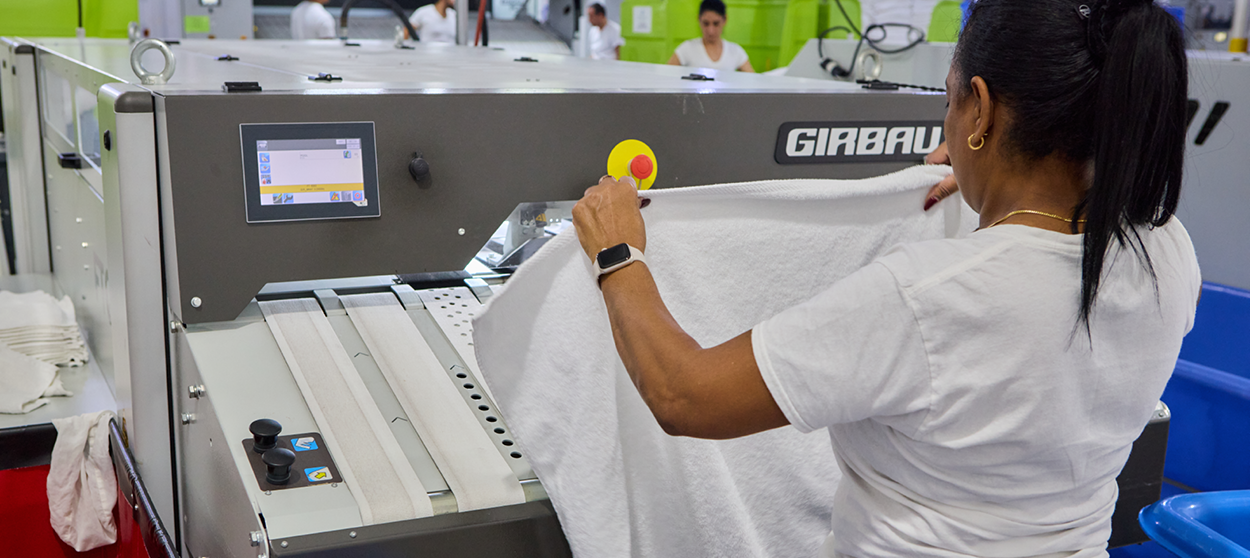
Laundries processing 250-500+ laundry pounds per hour should consider adding a towel folder. Generally, a typical laundry operator can sort, fold and stack different-sized towels by hand at a rate of 120 pieces per hour. By adding an auto-sorting towel folder, that same operator can fold and stack 800-1000, with just one operator. If you do the math on 120 hand folded towels versus 800-1,000 machine folded towels per hour, the savings is more than eight labor hours per day!
Hand Folding vs. Ironer with Sheet Folder
Starting with no automation as a baseline. One person is able to hand fold about 60 large dimension sheets per hour.
Folding efficiency can be increased using a flatwork ironer with an integrated primary folder, the X-Series ironers from Continental West have an integrated primary folding function. An actuating
drape bar performs an accordion fold, so on discharge, the sheet is the same dimension left to right, but front to back it’s 14-17”. Once the sheet is delivered back to the front the operator manually performs the crossfold and stacks. Using (2) operators a laundry can produce 60-120 per hour.
Now let’s go full automation with the Compact Pro All-in-One Ironing System. With the single station spreader-feeder option, a single operator can produce 180-300 sheets per hour. Using compressed air blasts and pinch rollers, the Compact Pro is able to process large dimension sheets with machined precision.
If you do the math on 60 hand-folded versus 300 machine-processed sheets, the savings is more than 5 labor hours per day!
Value #2: Gains in Quality
Some laundries, especially those processing hospitality laundry, require a high-quality finish, fold and stack. This uniformity can only be accomplished using automation — towel folders and flatwork ironer/folders. These uniform folds and stacks not only look better, they take up less space in storage areas.
Value #3: Return on Investment (ROI)
Remember there are always two costs when you buy: the cost of the machine may seem like a lot, but what is its operational impact? Compare your finance payment to operational cost savings. Many times, the difference in labor costs will make up for your financed equipment payment each month! Check out the estimated ROI for a GI towel folder and all-in-one ironing system below: