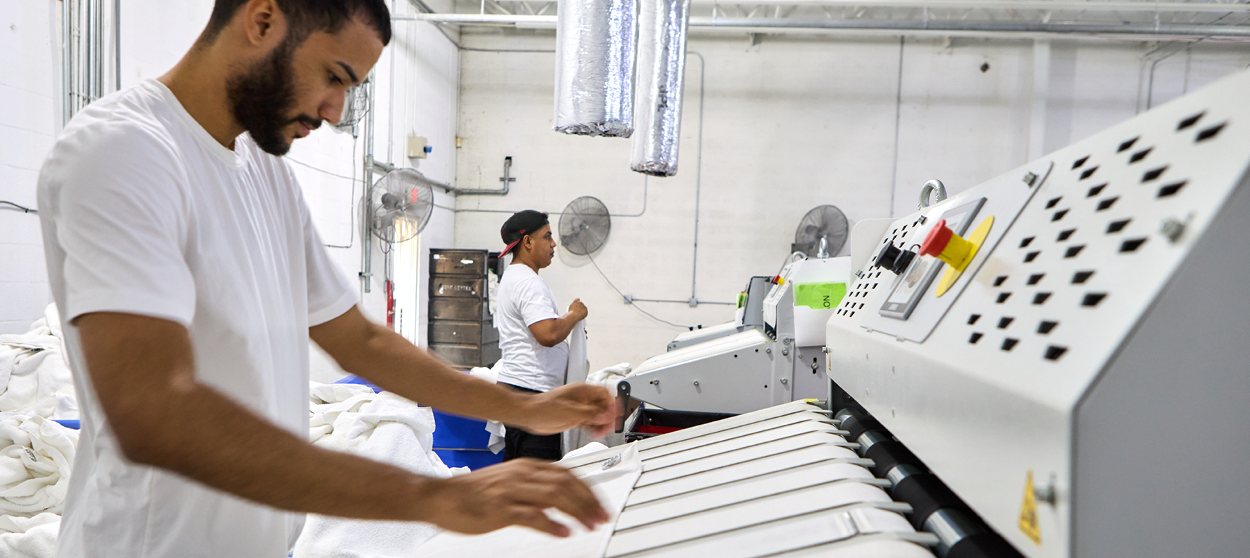
Starting from scratch, Whistler Laundry Inc., in Whistler, BC., stepped into laundry automation a little at a time. The commercial laundry started with three washers and three dryers. It quickly added more washing and drying capacity, along with a heated-roll ironer and integrated folder. Production, quality and profits escalated.
“That first ironer improved production and revenue 30 percent,” said co-owner Steve Wheeler. By the end of year four, the laundry had invested in an all-in-one feeder/ironer/folder/stacker/accumulator — boosting production and quality another 30 percent.
“We’ve grown way quicker than we expected,” added Wheeler. “We’re getting close to a production threshold again as we are very, very busy. The next logical step in automation might be a tunnel washing system so we can serve even larger hotels.”
In this example, Whistler Laundry started small and stepped into automation when the time was right. When it comes to taking the leap into automation, investing in one piece of equipment can significantly impact quality, production and per pound laundry processing costs. If you’re at a crossroads and considering automation, remember that you aren’t alone in determining whether it makes sense. Contact Continental West to help you assess if and when the time is right.
Here is some insight into how to get the most out of your laundry as you move into automation. The first step is to ensure an efficient and productive wash/dry process.
Washers & Dryers
A solid wash/dry process is key to lower processing costs. Critical to a laundry’s wash line are washers and dryers sized to meet your production goals. For optimum productivity and efficiency choose washers offering a soft-mount industrial design, high-G-force extract, excellent efficiency, flexible programmability, automatic chemical injection and options for auxiliary heat and steam, ozone and reclamation systems. Similarly, select efficient dryers with phased programmability, automatic reversing and moisture sensing. Here’s why:
Soft-Mount Design
Freestanding washers make for simple, less-costly installation, without bolt-down and allow for close installation clearances of less than a half inch. By comparison, hard-mount equipment requires reinforced concrete foundations, bolt-down and clearances of up to 18 inches or more. Soft-mount machines installed right next to each other provide for increased wash production per square foot and improved workflow.
High G-Force
In general, soft-mount washers generate higher G-Force extract than hard-mount washers. Or, if hard-mount washers do hit high-speed extract, it’s only for a short duration at the end of the spin cycle. That’s why a soft-mount washer generally removes more moisture during extract — reducing dry time by up to 50 percent.
Flexibility
A flexible control is vital to laundering a variety of items. Washers should offer programmability of automatic chemical injection and control over G-force, number of baths and rinses, water temperature, cycle times and water levels. Also critical are auxiliary heat and steam options. On the dryer side, look for phased programmability, efficient, affordable heat sources and control over automatic reversing and moisture sensing in order to reduce wrinkling and over-drying.
Efficiency
Choose efficient machines that reduce consumption of utilities and their associated costs. It’s important to realize that high G-force washers will shorten dry time, resulting in less natural gas consumption by the dryer — cutting utility costs.
Compact Footprint
Choose washers and dryers that feature bigger basket capacities, yet smaller footprints. There are models on the market that output considerably more production, using less labor and energy, when compared with other options occupying a larger area.

Adding a Flatwork Ironer
If your laundry wants to offer a higher quality finished product, it might be time to add an ironer. A basic ironer provides a high-quality finish that improves the look and feel of bed sheets, linens and tablecloths. Additionally, most ironers offer an integrated folder that performs primary folds on king or queen sheets after they are ironed. Thus, operators only perform cross-folds and stack. There is a significant, visible difference between pressed and non-pressed sheets. If your commercial laundry serves the hospitality industry, you’ll provide a better finished product and likely open the doors to new business and larger accounts. Meanwhile, your laundry will catapult productivity and lower dryer usage and costs because items move straight from the washer through the ironer. Thanks to less dryer wear and tear, linens should also last longer.
A basic flatwork ironer is able to iron over 120 sheets per hour using two operators.
Adding an All-In-One Feeder, Ironer, Folder, Stacker & Accumulator
When a laundry processes between 180 and 260 pounds of laundry per hour, it might be time for an all-in-one that automatically irons, folds and stacks. An all-in-one eliminates almost all hands-on flatwork folding and stacking. Using a basic flatwork ironer, operators must feed, catch and perform the cross folds. With a higher-production, all-in-one machine, operators feed sheets. The primary folding, cross folding and stacking are all automatically performed for boosted quality and production.

Adding a Towel Folder
The most compelling reasons to move from hand folding to an automatic folder is improved production, enhanced quality and labor efficiencies. Laundries processing 250-500+ pounds of laundry per hour should consider adding a towel folder. Generally, a typical laundry operator can sort, fold and stack different-sized towels at a rate of 120 pieces per hour. By adding a towel folder, a laundry can fold and stack at least 800 pieces per hour, with just one operator.
Through automation, and the installation of an auto-sort folder, laundries can cut labor hours by 87 percent.
Whether you run a small laundry or a large operation, the goal is the same: get more done in less time. The right equipment and workflow can improve efficiency, deliver more consistent results and ease the burden of labor — helping lower processing costs and strengthen your bottom line.